
 Français
 Español
 Deutsch
 English
Volleyball Court Lighting: Lux, Uniformity, Layout and LED Control
For a volleyball court, lighting must ensure fast ball tracking, good uniformity across the playing area and visual comfort for players, referees and spectators. STADÉLUM supports projects through site analysis, photometric calculations, luminaire layout, SUPRALED selection and control scenarios adapted to the use of the sports hall.
Overview: Precise Lighting to Follow the Ball
Volleyball is a fast sport involving high ball trajectories, play at the net and frequent changes of direction. Lighting must therefore avoid dark areas, limit glare and maintain good uniformity across the entire playing area.
In a multi-sport hall, STADÉLUM also checks height constraints, net position, free zones, other sports markings, natural light contribution and lighting control possibilities.
Key Points Checked by STADÉLUM
- Avoid luminaires directly above the net area.
- Check average illuminance and uniformity across the useful playing area.
- Adapt the lighting level to the targeted classification.
- Provide DALI scenarios for training, competition and switch-off.
1. Volleyball Court Dimensions
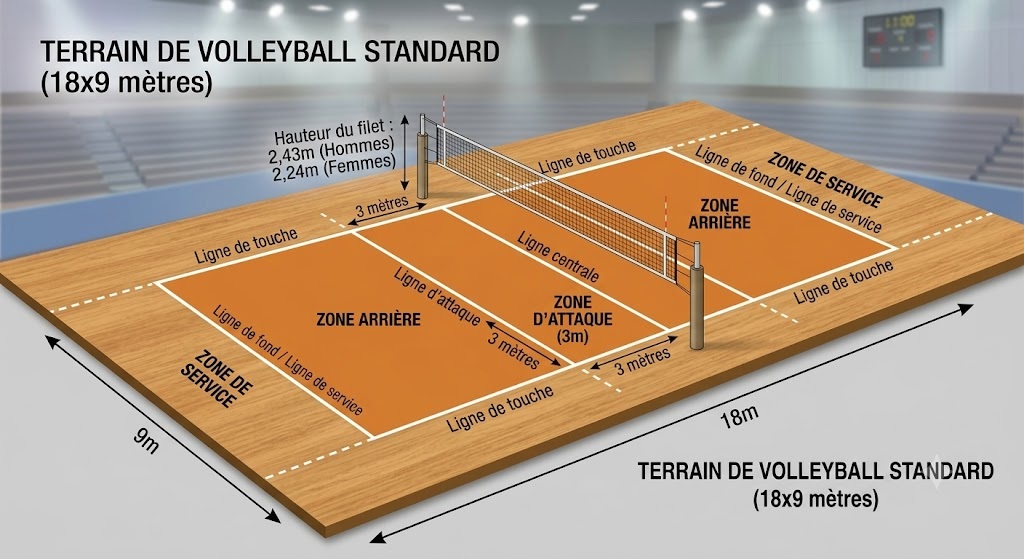
A standard volleyball court measures 18 × 9 m. The sports hall must also take into account the free zones around the court, available height, net position, posts, scorer's table and any warm-up areas depending on the level of play.
2. Illuminance Levels: Define the Target Before Selecting the Luminaires
The target level depends on the actual use of the sports hall, the level of competition, the other sports played and, for high-level competition, broadcasting requirements. Values of 500, 750 or 1000 lux can be used as design reference values in a sports hall study, but the applicable specifications must always be confirmed.
A project reference value frequently studied for local competition halls, to be confirmed according to use and the applicable regulations.
A design range to be confirmed according to the level of competition, the sports hall and any additional requirements.
For FIVB, World and Official Competitions, measured at 1 m above the playing area.
3. How to Read a Volleyball Photometric Study
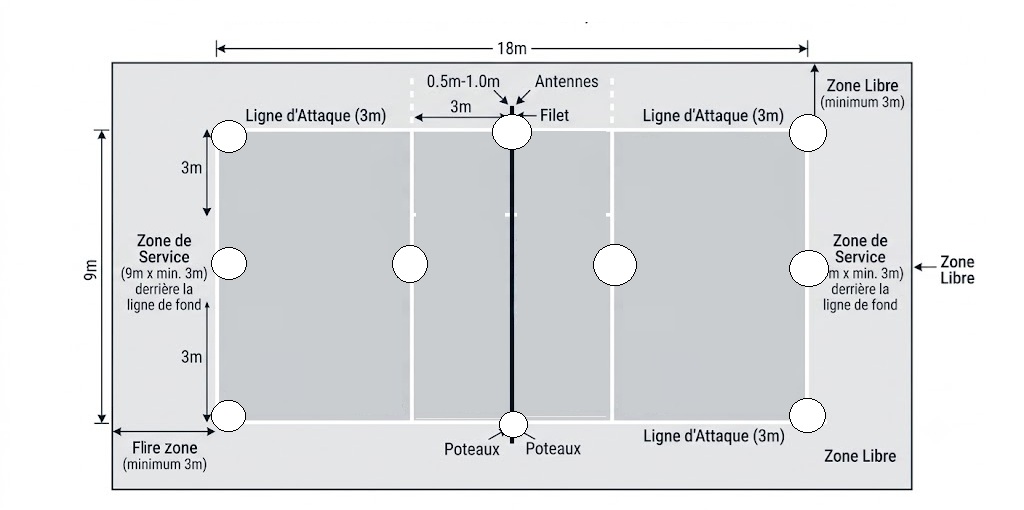
The STADÉLUM example on this page uses a 10-point calculation grid at a height of 1 m. It is used to compare the calculated values across the playing area: average, minimum and maximum illuminance, as well as uniformity. This grid belongs to the study presented here and is not shown as a universal regulatory protocol for on-site measurements.
Four Values to Consider Together
- Eavg: average level calculated across the grid.
- Emin: lowest point, useful for identifying an underlit area.
- Emax: highest value, useful for assessing differences.
- U0: Emin / Eavg ratio used to assess the uniformity of the light distribution.
4. STADÉLUM Photometric Study Example: 14 SUPRALED Luminaires
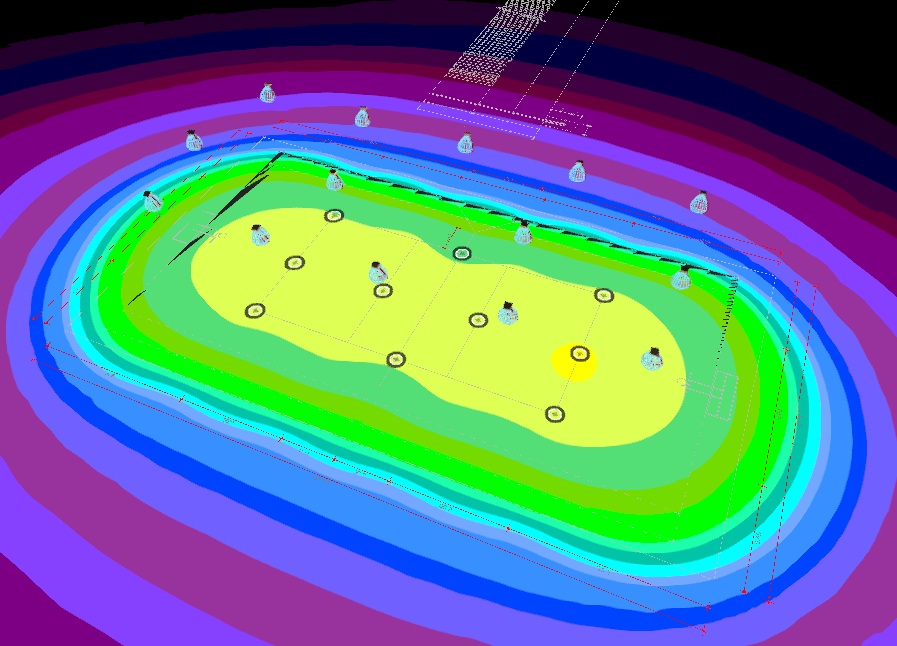
The example below presents a configuration for a regional / departmental level using 14 SUPRALED 150 W 4000 K luminaires. The simulation achieves an average of 610 lux and U0 uniformity of 0.75. In this configuration, the luminaires are distributed so that light sources are not concentrated in the net area, helping to preserve ball visibility.
Studied Configuration
- 14 SUPRALED luminaires, 150 W, 4000 K.
- Layout distributed around the playing area, with no luminaire directly above the net.
- Target: regional / departmental level.
- Average illuminance: 610 lux.
- Uniformity: 0.75.
Calculated Results for This Layout
The values below correspond to the layout presented in this section: 14 SUPRALED 150 W 4000 K luminaires. They are integrated directly into the page, with a collapsible section to keep the presentation compact.
Study Calculation PointsClick to collapse or expand
| Point | Value |
|---|---|
| 1 | 620 lux |
| 2 | 773 lux |
| 3 | 544 lux |
| 4 | 678 lux |
| 5 | 535 lux |
| 6 | 456 lux |
| 7 | 678 lux |
| 8 | 588 lux |
| 9 | 719 lux |
| 10 | 515 lux |
Reading the Result
The average is 610 lux. The lowest point is 456 lux. Uniformity is rounded to 0.75, meeting the U0 ≥ 0.70 target for this regional / departmental study configuration.
SUPRALED as the Sports Hall Reference, with SMASH or COURTLINE to Compare Depending on the Project
The luminaire must remain the result of the study. For a volleyball sports hall, SUPRALED is the reference solution. SMASH or COURTLINE can be compared in specific configurations where the height, fixing points or geometry of the sports hall justify a different approach.
SUPRALED
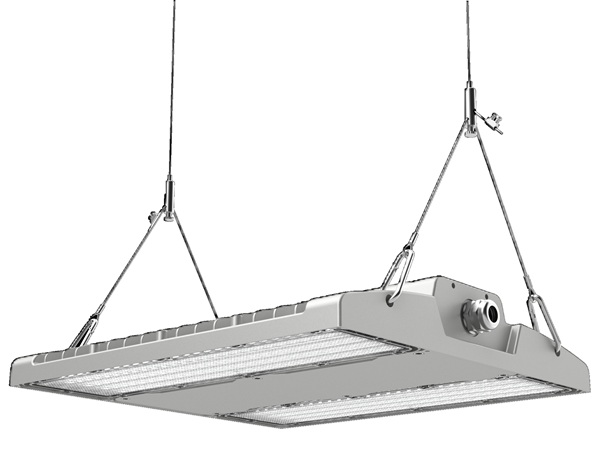
Designed for sports halls and multi-sport facilities. The photometric example on this page uses 14 SUPRALED 150 W luminaires in 4000 K. The technical data sheet notably documents DALI, IP66 and IK10.
The final configuration depends on the height, layout grid, required lighting level and other uses of the sports hall.
View the SUPRALED product page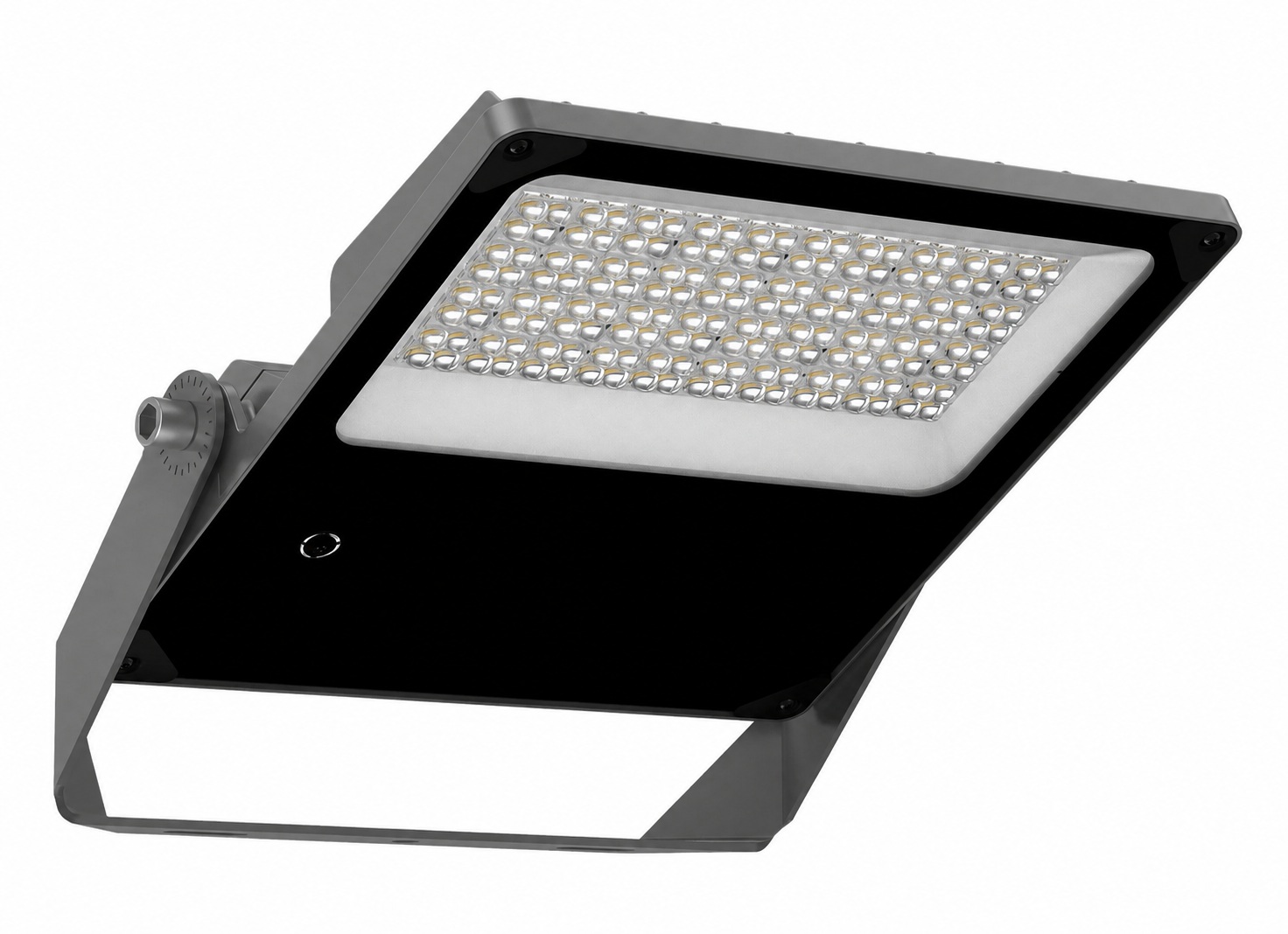
SMASH
It can be studied when the building geometry or fixing points require adjustable floodlights. For indoor volleyball, the choice must be confirmed by photometric calculations and by the mechanical constraints related to the luminaire position.
View the SMASH product page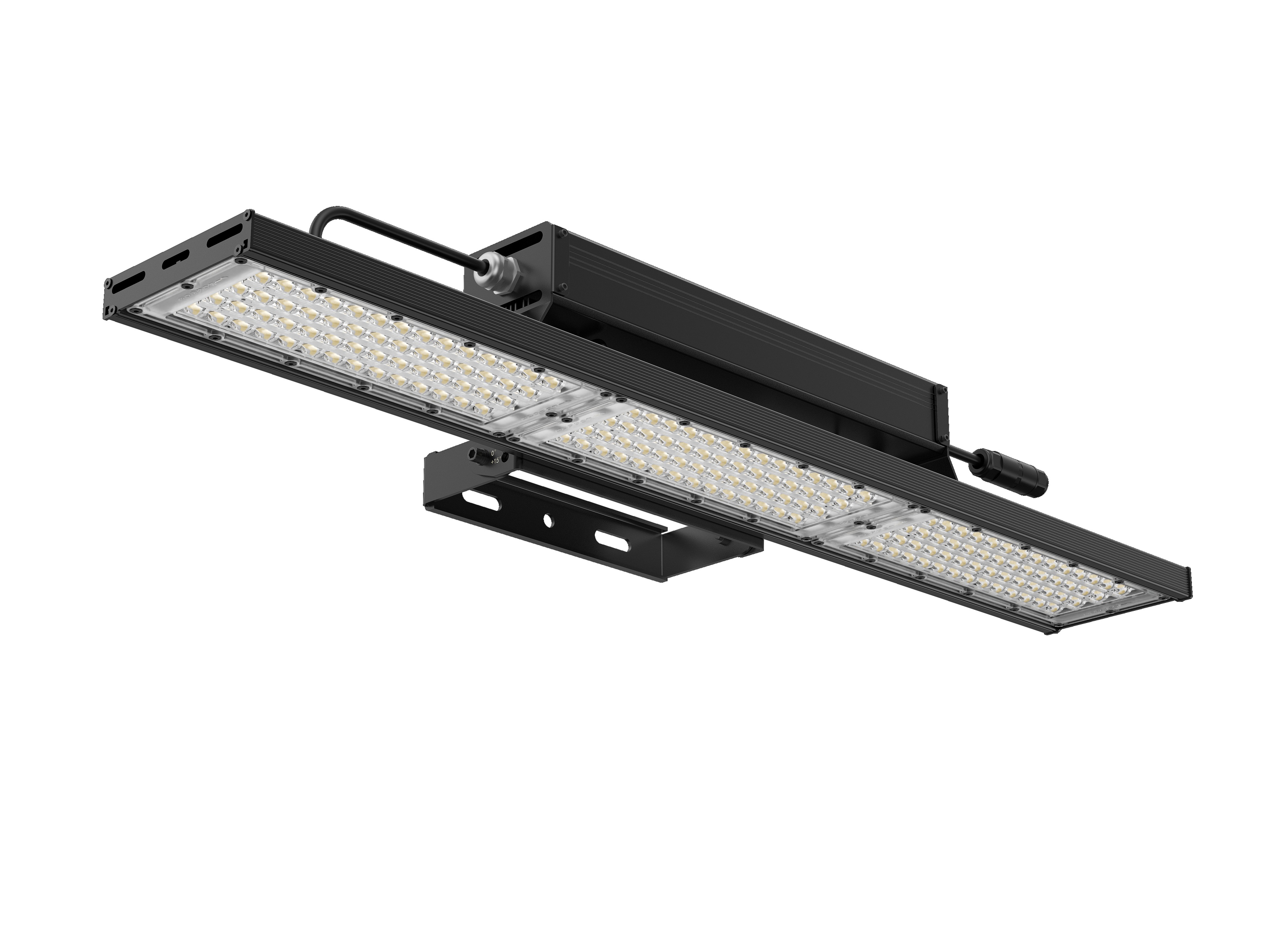
COURTLINE
Its linear shape may justify comparison when fixing points or the building structure require a particular layout. It is not presented as the default volleyball solution: its use must be validated through the study.
View the COURTLINE product page6. DALI Control, Scenarios and Natural Light
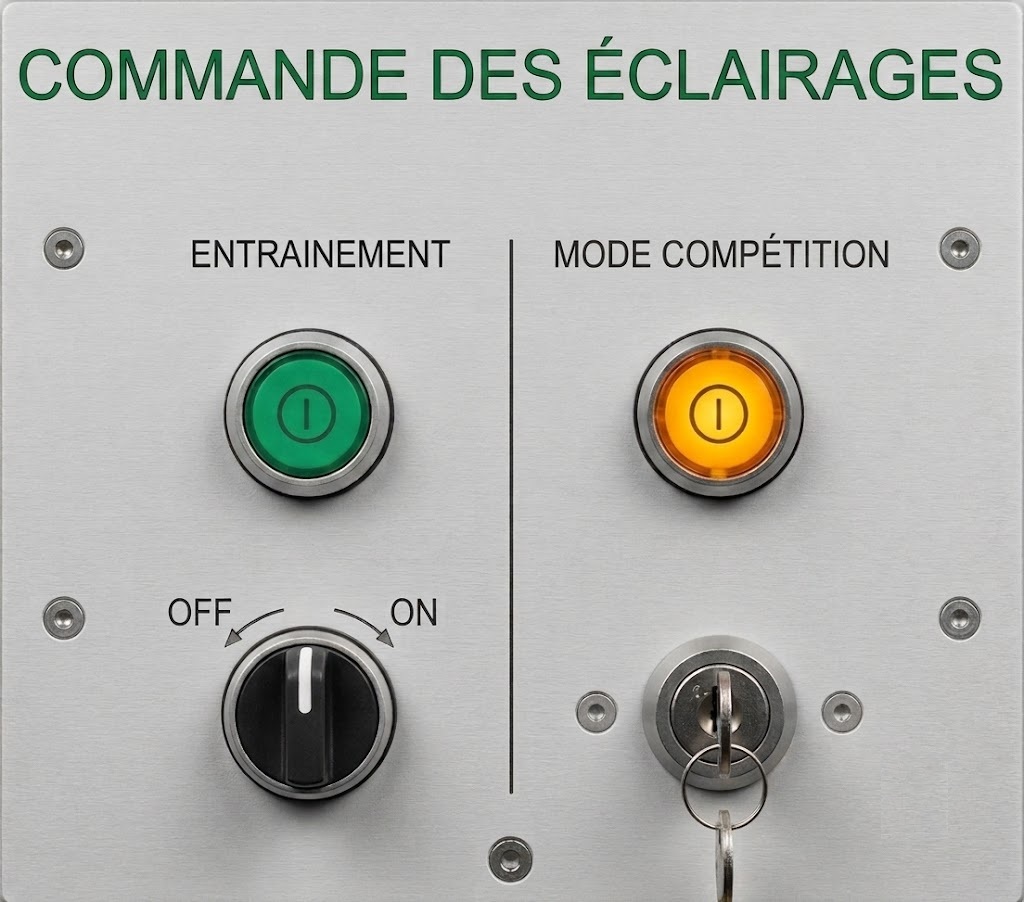
SUPRALED luminaires can be controlled using DALI to adapt the lighting level to the actual use of the sports hall. This approach avoids operating permanently at maximum output when it is not necessary.
- Training scenario: reduced level to limit energy consumption.
- Competition scenario: level adapted to the targeted sports classification.
- Switch-off scenario: simple switch-off outside operating periods.
- Daylight sensors: dimming according to available natural light.
- Presence detection: possible option depending on building operation.
FAQ — LED Volleyball Court Lighting
How many lux should be provided for a volleyball court?
The required level depends on the project specifications. Targets of 500 to 1000 lux can be studied depending on the level of play and use of the sports hall. For FIVB, World and Official Competitions, the FIVB 2025-2028 rules specify at least 2000 lux measured at 1 m above the playing area.
Why is uniformity important in volleyball lighting?
Uniformity limits differences between underlit and excessively bright areas. It improves ball perception, reading of play at the net and players' visual comfort.
How can visual discomfort near the net be reduced?
The net area is sensitive because players often look upwards. The study must therefore control the position of the light sources, their optics and their aiming angles to preserve ball visibility and limit glare.
Can volleyball share the lighting of a multi-sport hall?
Yes, but the requirements must be considered alongside those of the other sports. A photometric study makes it possible to verify that the lighting level, uniformity and distribution remain consistent for all uses of the sports hall.
Why use DALI control?
DALI control makes it possible to adapt the lighting intensity to different uses: training, competition, switch-off or dimming. It can also be combined with daylight sensors to take natural light into account.
Can SMASH or COURTLINE be used for a volleyball court?
They can be compared in certain specific configurations, but SUPRALED remains the reference sports hall solution on this page. For SMASH or COURTLINE, photometric performance, luminaire positioning and mechanical constraints must be validated before specification.
Does the 610 lux study correspond to measurements taken in a sports hall?
No. The average 610 lux, minimum 456 lux, maximum 773 lux and U0 0.75 are calculated values from the photometric study presented. They must not be considered as on-site measurements taken after installation.
View Our Sports Hall Lighting Projects
The published projects show how STADÉLUM addresses the real constraints of a multi-sport hall: height, renovation, layout, installed power, uniformity and luminaire selection.
View sports hall projectsSTADÉLUM Studies Your Sports Hall Before Pricing the Luminaires
Dimensions, available height, sporting level, lux, uniformity, net position, layout, visual comfort, DALI control and natural light: every parameter must be checked to provide a consistent solution.
Request a technical preliminary study